

Split system air conditioning
Split system air conditioning explained
Nearly every fixed air conditioner in UK homes is a split system. Here’s how the two halves work together, what one costs to run, and how to choose between single and multi-split — before we install one in your Surrey home or business.
Get your free quote
Tell us what you need and we’ll get back to you, usually within 24 hours.
How it works
How does a split system air conditioner work?
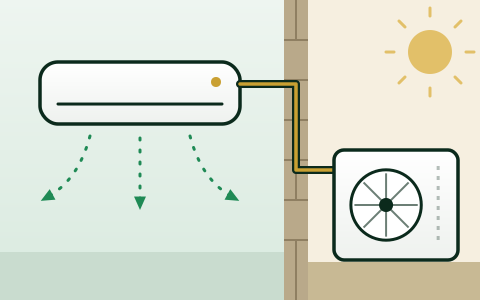
A split system is “split” into two parts connected by refrigerant pipework:
The indoor unit (evaporator)
A fan draws room air across a cold coil. Refrigerant inside the coil absorbs heat, and moisture condenses out of the air and drains away — which is why air conditioning also dehumidifies.
The outdoor unit (compressor and condenser)
The compressor pumps the warmed refrigerant outside, where the condenser coil and fan release the heat to the outside air.
The refrigerant circuit
Most current models use R32 refrigerant, which has a much lower global warming potential than older refrigerants. In heating mode a reversing valve swaps the roles of the two coils, turning the system into an air-to-air heat pump.
Compare
Split system vs portable air conditioner
| Fixed split system | Portable air conditioner | |
|---|---|---|
| Efficiency | High — inverter compressor outside the room | Low — compressor and heat inside the room |
| Noise indoors | Very quiet | Loud, similar to a dehumidifier |
| Window | Closed and secure | Kept open for the exhaust hose |
| Heating | Yes, as a heat pump | Rarely |
| Lifespan | Typically 10–15 years with servicing | Often a few seasons |
Running costs
How much does a split system cost to run?
Running costs depend on the unit’s efficiency, the room and how long it runs, but the numbers are smaller than most people expect. A typical 2.5kW bedroom unit with good seasonal ratings draws well under 1kW at full output — and much less once the room is at temperature and the inverter slows down.
At an electricity price of around 25p per kWh, that works out at pennies per hour for most of its running time. Using a timer, a sensible set temperature (around 21–24°C in summer) and keeping filters clean all help keep costs down.
Can a split system replace electric heaters?
For many rooms, yes. Because a heat pump moves heat rather than generating it, it typically produces three to four times more heat than the electricity it consumes, while plug-in electric heaters convert electricity to heat one-for-one. Note that air-to-air heat pumps aren’t eligible for the government’s Boiler Upgrade Scheme, which covers air-to-water systems.

Single or multi?
Single split or multi-split: which do you need?
A single split pairs one indoor unit with one outdoor unit. It’s the simplest, most efficient way to serve one room, and if it ever needs attention, only that room is affected.
A multi-split connects several indoor units to one outdoor unit. It saves wall space outside and suits homes cooling two to five rooms, but every room depends on the same condenser.
Some homes have a mix: a multi-split for the bedrooms and a separate single split for a home office that runs all day.
Do split systems need ductwork?
No. Split systems are “ductless” — only a small bundle of pipes and cable passes through the wall, which is why they’re so popular for existing homes.
How far apart can the indoor and outdoor units be?
It varies by model, but domestic units commonly allow pipe runs of 15–25 metres. Shorter runs are more efficient and less expensive to install.
Do split systems need regular gas top-ups?
No. A correctly installed system is sealed. If it needs topping up, there’s a leak that should be found and repaired — see our repair service.
How long does a split system last?
Typically 10–15 years with annual servicing, often longer for systems that aren’t run hard.
Get in touch
Get a split system installation quote
Let us know the room and where the outdoor unit could go, and we’ll confirm the right system and a fixed price.